Do It Yourself Sash Window Cord Replacement
Replacing sash cords or sash ropes is a relatively simple procedure for a competent diy person. Should you wish to completely recondition a sash window or simply need to remove the sashes to get large furniture into the property then these guidelines can be utilized. These guidelines are for the most common sliding box sash windows encountered. It should be remembered however that not every sash window is exactly the same and regional variations are not uncommon.
White 6mm braided marine rope / cord is ideal as it will last forever and does not stretch. Using cheap cord is a false economy as the saving is small and a budget cord may stretch over time. If the cords become too long the top sash will not close properly because the weights have bottomed out.
These guidelines are written for the work to be undertaken from inside of the property.
Not all sash windows have cords. Alternative balance systems are discussed in a seperate article.
How does a sash window work?
 A box sash window operates by counterbalancing the weight of the sash against weights attached to a cord and passed over a pulley. These weights (usually cast iron, sometimes lead) travel up and down in a box, concealed within the window frame, hence the name Box Sash Windows. A dividing strip (wagtail) is often suspended within the box to prevent collision of the weights.
Access to the weights is by means of a removable pocket, usually cut into the inside of the box lining but occasionally found on the inner box face, hidden behind wooden shutters.
Parting beads are set into grooves running down the middle of the linings, holding the pockets in place and forming a channel for the outer, top sash. The channel for the inner, bottom sash is formed by the parting bead and staff bead, running around the inside perimeter of the frame.

Remove the staff bead

Using a sharp knife carefully slice along any paint joint formed between the staff beads and the box frame, this will minimize disruption to the paintwork.
Using a mallet and a blunt chisel (25mm+) or block of wood, gently tap the beads in towards the centre of the window. The chisel should be positioned into the small recess at the back of the staff bead, starting midway along the longest bead, where it can flex the most. Once a gap has been opened up the bead can be levered out, being sure to avoid injury on the protruding nails. Repeat this procedure for the remaining side and bottom beads. The top staff and parting beads remain in place at all times. De-nail the beads and set aside for reuse or disposal.
Remove The Bottom Sash
If new cords are to be fitted: one at a time hold and cut the cord, just above where it emerges from the bottom sash and tie a knot in the end. Allow the weight to be lowered inside the frame, until the knot sits at the pulley: Remove the sash.
If the cords are to be reused: prise out the pins attaching the cord to the sash and tie a knot in the cord, slowly allow it to rest at the pulley. Remove the sash.
Remove the parting beads
Using a sharp knife, slice along any paint joint formed between the parting beads and the box window frame. Gently prise the parting beads from their narrow grooves. Parting beads are made to be a snug fit for the groove, with no fixings, but some have subsequently been nailed in place.
Remove the top sash
BEWARE it may have been fixed shut because of broken cords and might drop when released.
If the top sash is inoperable it is usually painted shut, but also check for nails or screws fixing it in place. Carefully slice along any paint joints with a sharp knife, and tap the sash gently until it is free, often tapping upwards on the sash horns works. Remove the cords & tie knots as you did with the bottom sash.
Remove the Pockets
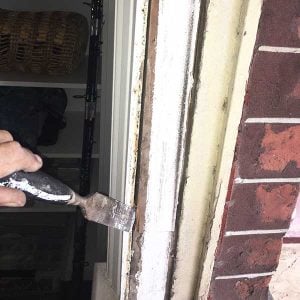
The pockets should now be visible, using a sharp knife slice along the paint joints around the pockets and gently prise them out. Like parting beads, the pockets are made to be a snug fit, but over the years many have been pinned/screwed into place – look for screw or nail marks on the inner face if the pocket is not moving.
Remove the weights

The bottom of the weights should be visible hanging in the pocket, untie the knot currently suspending the weight and remove the weight. It is easy when removing the weights to trap a finger – be careful.
Carefully inspect the sashes and the frame for any damage. Chop out all damaged wood and repair with an epoxy filler or splice in fresh timber.
Preparing the frame
Using a scraper remove any excessive paint build-up and sand smooth the inner surfaces of the box frame, ready for repainting.
Ensure that all of the pulleys are free rolling, use a spray lubricant on the bearing to eliminate squeaking.
Prime/undercoat any bare wood before repainting the frame, exterior grade acrylic paints are well suited to this purpose because of their fast drying times.
%22%20transform%3D%22translate(.6%20.6)%20scale(1.17188)%22%20fill-opacity%3D%22.5%22%3E%3Cellipse%20fill%3D%22%23ece8ff%22%20rx%3D%221%22%20ry%3D%221%22%20transform%3D%22matrix(-56.01344%2073.13241%20-86.7603%20-66.45129%20158.2%2014.7)%22%2F%3E%3Cellipse%20rx%3D%221%22%20ry%3D%221%22%20transform%3D%22matrix(-57.96155%2066.44257%20-90.48616%20-78.9361%2043.1%20204)%22%2F%3E%3Cellipse%20fill%3D%22%23040702%22%20rx%3D%221%22%20ry%3D%221%22%20transform%3D%22matrix(-51.45253%20-72.40074%2048.27335%20-34.30609%2046.2%20212.4)%22%2F%3E%3Cellipse%20fill%3D%22%23b6a6ff%22%20cx%3D%22178%22%20cy%3D%2214%22%20rx%3D%22141%22%20ry%3D%2228%22%2F%3E%3C%2Fg%3E%3C%2Fsvg%3E "How To Replace Sash Cords - DIY 7") Preparing the sashes
Preparing the sashes
 Preparing the sashes
Remove old nails and cord from the grooves.If any of the sash joints are loose, re-secure them by glueing & re wedging the tenons. 2 part epoxy filler also works well to bond open joints.
You may also decide to repair broken glass and/or re-paint the sashes whilst they are out. Any missing or loose putty should also be replaced.
Balancing the sashes
For sashes to slide easily, it is important that the weights and sash are equally balanced. Whilst the weights would have suited the original glass, glazing repairs may have used thicker, heavier glass which puts the system out of balance.
Once any glass repairs have been completed, weigh the pair of weights together and then the sash, bathroom scales are suitable. Adjust deficiencies using lead ‘make up’ weights (see below). It is ideal for the top sash weights to be slightly heavier, ensuring the sash pulls up tight to the head when closed.
Replacing the cords
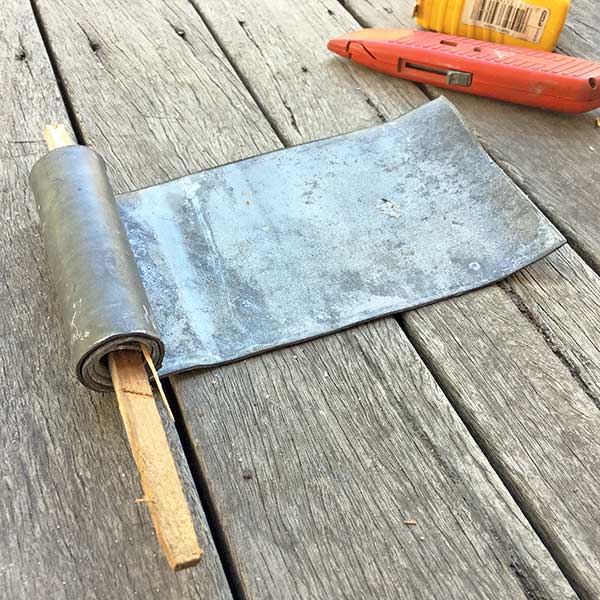
 Pass replacement sash cords through the pulleys and down out of the pocket. Often a ‘mouse’ is required – Simply attach a small weight (small enough to pass through the pulley – traditionally made of lead but you can try a nail) to the end of a piece of string (the mouse), drop it over the pulley and out of the pocket, to be used as a draw wire to pull the larger sash cord through.
Securely attach the cord to the weight with a suitable knot or hitch, being sure to include any make-up weights. Guiding the weights as you pull the cord from the pulley, to hoist the weights back into place.
Cut the cord leaving approx. 300mm protruding from the pulley & tie a loose knot to prevent it from slipping back inside the frame.
If there is no ‘wagtail’ dividing strip, between the weights, and the window is out of vertical ‘plumb’ alignment then it is possible that one weight can sit on top of the other during use, stopping the window from working. It may be necessary to cut a strip of hardboard or thin plastic sheet and pass it up between the weights and pulleys.
Note: There are other methods for cutting the cord, that minimise waste, but this procedure is the most straight forward for a novice.
Re-hanging the top sash
 Individually pull the rear cords until the weight is at the top of the box, against the pulley. Temporarily nail the cord to the box frame, leaving the head protruding for easy removal. It is only there to hold the weight in place as you attach the cord to the sash. Put this nail/pin where the staff bead goes & about 1/3 of the distance down from the top of the window, making sure it is well above the height of the sash meeting rails. The weight is now suspended allowing you to work unhindered as you attach the cord to the sash.
Cords are fixed either by being nailed into a groove (1” round-head nails or blued carpet tacks are ideal) or suspended by a knot. If yours are of the knot type it will be obvious, as you already removed the old cords.
Sit the sash in position on the window sill and then tilt it forward to fix cords. You may have a little excess cord that needs to be cut off. When nailing cords 3 or 4 firmly fixed nails per cord is all that is required. Keep them to the middle of the frame and none within 6 inches of the sash edge. As the window passes over the pulley, it should not encounter nails. (If the distance between the top of the box and the bottom of the pulley is X then make sure your top nail is no closer than X+20 mm from the top of the sash.)
Remove the temporary nails suspending the weights and allow the top sash to slide into place. Pull the sash through its full vertical travel, if excessive side to side movement occurs then the sashes should be packed using timber fillets; if it binds, then it will need to be planed down.
NOTE: If your window is wider than it is tall then the length of the cords may have to be reduced, which will also reduce the opening distance of the sash. This is due to the long weights required to balance wide glazed frames.
Replace the parting beads
Parting beads may need to be sanded to ensure that they fit snug into their grooves. Replace pockets and tap parting beads into place. Seal along the gaps with decorators caulk.
Replace bottom sash
The bottom sash rail may need planing, to bring the two meeting rails of the sashes level. Hang the bottom sash in the same way as you did the top.
Replace staff beads
 These should be securely nailed into place, ensuring that they are not so close as to restrict sash operation and not so wide as to allow the sash to rattle. Leave the nail heads protruding, for adjustment, until you have checked the window is sliding without catching. Drive nails home and punch below the surface. Use decorators caulk to seal the gap between the staff bead and box to reduce draughts and improve the painted finish.
Hardware
Check that catches and locks are correctly aligned and fully functioning
Lubricate
Once all paintwork is completed, a coat of silicone spray on the running stiles will help to improve running performance.